Cross Margin vs Isolated Margin: Choosing the Right Margin Mode
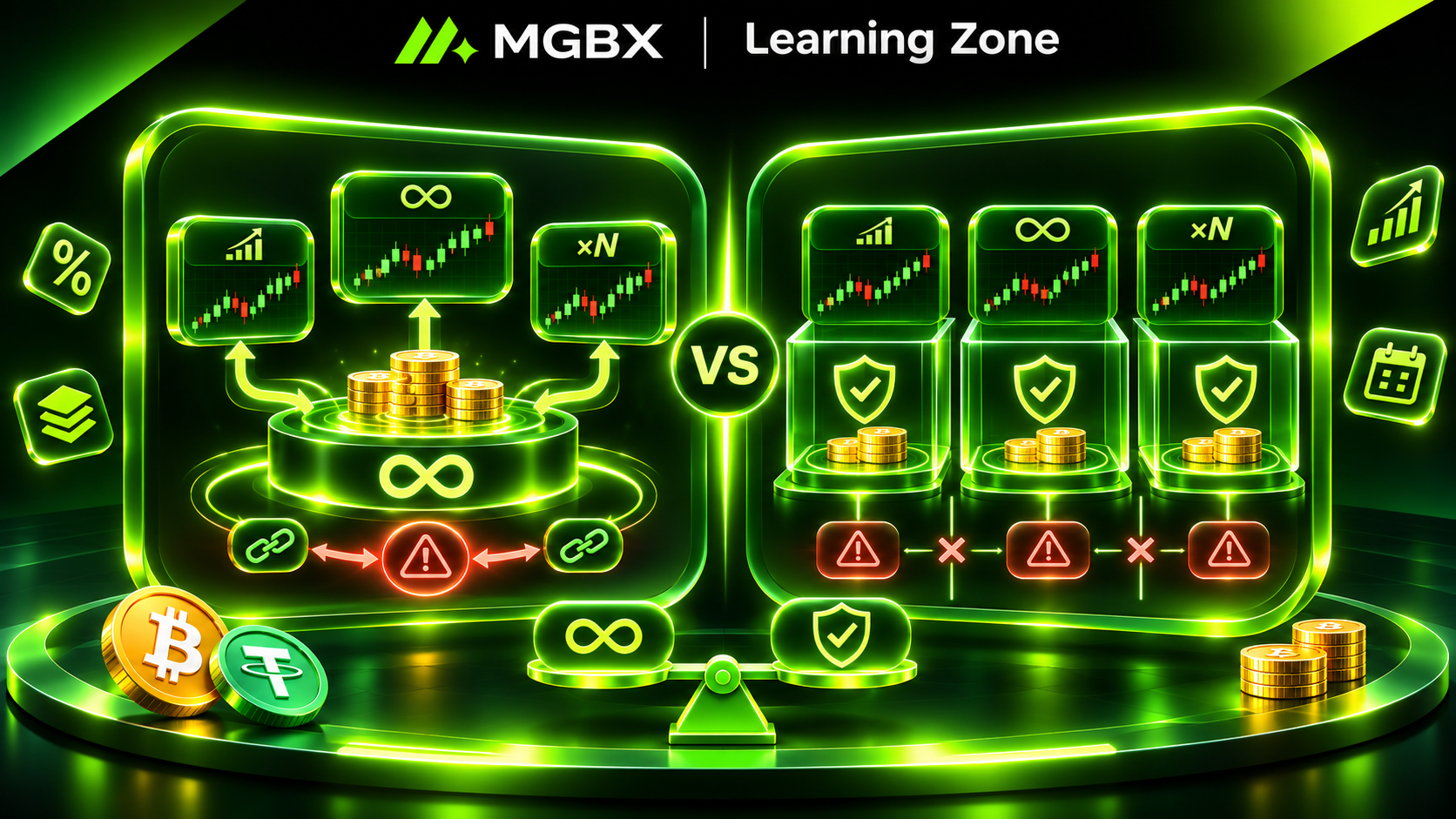
Cross margin and isolated margin determine how margin is allocated across futures positions. Cross margin generally allows eligible positions to share available account margin, offering more flexible capital allocation but potentially exposing more account funds to losses from a single position. Isolated margin keeps margin relatively separate for each position, making it easier to limit risk to an individual trade. Understanding the differences between these two margin modes is an important part of building a sound futures risk management framework.
Cross Margin vs Isolated Margin
The core principle of cross margin is shared margin. When one position incurs an unrealized loss, available margin may be used to support that position. This structure provides greater flexibility in allocating funds across positions, but it also creates a higher degree of risk linkage between them. If one position continues to generate significant losses, it may affect the available margin across the entire cross-margin account.
Isolated margin, by contrast, focuses on margin separation. Traders allocate a specific amount of margin to an individual position, and that position primarily relies on its assigned margin to absorb price fluctuations. If an isolated-margin position is liquidated, other independent positions generally are not automatically used to support it in the same way as under cross margin.
The key difference between the two modes is therefore not which one is inherently safer, but whether risk is shared across a broader pool of funds or kept as contained as possible within an individual position.
Cross Margin vs Isolated Margin: Key Differences
The two margin modes can be compared across several areas:
Comparison | Cross Margin | Isolated Margin |
Margin | Eligible positions share funds within a defined margin scope | Margin is allocated separately to each position |
Risk Exposure | Losses may affect a larger portion of account margin | Risk is primarily limited to an individual position |
Capital Allocation | More flexible | More independent |
Position Management | Focuses more on overall account risk | Focuses more on individual position risk |
Liquidation Impact | Requires monitoring overall margin status | Focuses more on the margin status of each position |
One advantage of cross margin is more centralized capital utilization. When an account has sufficient available margin, positions may have a larger buffer against short-term price fluctuations. However, a larger buffer does not necessarily mean lower risk. If a position continues moving in the wrong direction, more account funds may become exposed to the same loss.
Isolated margin makes it easier to define a clear risk boundary for each position. However, if only a small amount of margin is allocated, the position may have less room to absorb unfavorable price movements.
How to Choose a Margin Mode
There is no single margin mode that works best in every trading scenario.
If a trader manages multiple related positions and wants to use account margin more centrally, cross margin may offer greater flexibility. If the priority is keeping the risk of different positions more separate, isolated margin generally provides a clearer risk boundary.
Neither cross margin nor isolated margin can replace proper position sizing and stop-loss management. Other factors that influence risk include leverage, notional position value, market volatility, and the amount of available account funds.
In addition, whether traders can switch margin modes while holding open positions or active orders may depend on the specific product rules. Before trading on MGBX, users should review the latest rules for the relevant trading pair, as well as the real-time liquidation price and margin status shown on the trading page.
For more on the relationship between leverage, margin, and liquidation, read Leveraged Trading Explained: Amplifying Both Returns and Risk.
FAQ
Does cross margin mean I could lose my entire account balance?
Not necessarily. Cross margin allows margin within a defined account scope to support eligible positions, so losses may affect more funds. However, the actual liquidation process and loss exposure depend on the account structure and specific risk rules.Is the maximum loss under isolated margin always equal to the initial margin?
Not necessarily. The main feature of isolated margin is risk separation. If additional margin is added during the trade, the total capital committed to that position will increase, so the initial margin alone does not define the final risk amount.Is cross margin less likely to be liquidated than isolated margin?
Cross margin may provide a larger price buffer when more available margin can support the position, but it can also expose more of the account to losses. It should not simply be considered safer.Can I add margin to an isolated position?
This depends on the product rules. Where additional margin is supported, adding margin may change the position’s risk buffer and liquidation price.Can I switch between cross and isolated margin after opening a position?
Not always. Restrictions may apply when there are open positions or active orders, so traders should refer to the current rules shown on the MGBX trading page.
Mastering the basics is the first step. Follow MGBX Academy to access more cryptocurrency educational resources and market opportunities.
The process for trading on MGBX:
Register a trading account and complete the necessary identity verification;
Deposit funds and select a trade type;
On the cryptocurrency trading page, enter the amount or quantity of the cryptocurrency you wish to purchase;
Confirm the order to complete the trade, and check that your assets have increased accordingly.
Further Readings:
Complete Guide to Futures Trading: From Beginner Basics to Risk Management
What Is Futures Trading: Perpetual Futures vs Delivery Futures
Leveraged Trading Explained: Amplifying Both Returns and Risk
What Is a Funding Rate? How Perpetual Futures Stay Anchored to Spot Prices