Long-Term Strategies with Low Leverage: Is Consistent Profit Possible?
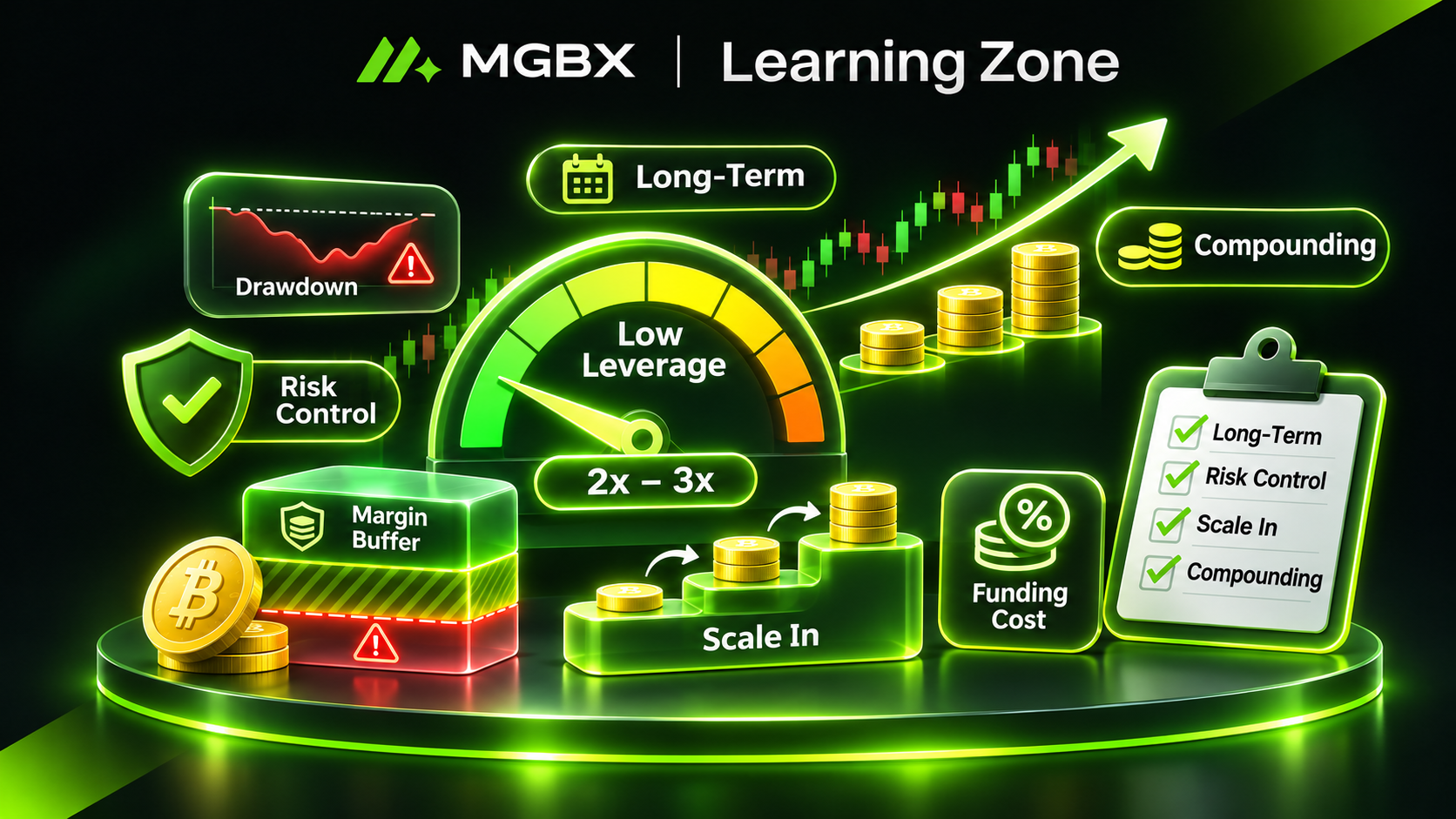
Low leverage can reduce margin pressure under certain conditions, but it cannot guarantee consistent returns. No leverage level is universally safe. Long-term strategies must account for market direction, position size, ongoing costs, and severe drawdowns. Scaling in does not ensure a low entry price, and reinvesting profits increases future risk. For long-term token holdings, compare unleveraged spot trading and assess whether leverage is justified by net performance and the risks throughout the holding period.
Lower Leverage Can Reduce Risk but Cannot Guarantee Returns
With position quantity unchanged and other conditions similar, adding margin generally increases the buffer. With the same margin, using lower leverage to establish a smaller position reduces gains and losses from a given price move. However, changing the leverage setting without changing position quantity does not necessarily reduce market exposure.
For example, ¥10,000 equivalent in margin supports a linear futures long worth ¥20,000. A 20% price decline produces approximately ¥4,000 in losses before costs, or 40% of initial margin. Even without liquidation, this is a substantial drawdown.
You cannot therefore assume that 2x leverage always withstands a 50% decline, or 3x leverage a one-third decline. Actual conditions also depend on maintenance margin, fees, and account mode.
How Should Holding Costs Affect Product Selection?
Spot borrowing incurs interest on outstanding debt, while perpetual futures require monitoring funding payments. Trading and position adjustments also involve fees and slippage. For a position worth ¥20,000 equivalent, paying 0.01% three times daily for 30 days totals approximately ¥180. This example assumes unchanged position value and funding rates solely to illustrate accumulating costs.
Funding rates can change, and payments may switch to receipts. Do not annualize one interval’s result as a reliable forecast or assume that a correct long-term view will cover costs. Dated futures generally do not use perpetual funding, but they expire, and rolling positions can involve price differences, fees, and execution costs.
How Do Scaling In and Compounding Fit a Long-Term Strategy?
Scaling in spreads entries over time but does not guarantee buying near the bottom. Repeated additions to leveraged positions also increase total exposure. Set a cumulative allocation limit and reassess risk after each addition.
Asset research can examine liquidity, supply changes, practical utility, and market concentration. However, even major assets can experience deep drawdowns. An oversold indicator does not prove that a decline has ended. Define when the holding thesis becomes invalid rather than using time already invested as a reason to stay.
Compounding works in both directions. Increasing capital after gains can magnify subsequent returns and losses: gaining 20% and then losing 20% leaves a net loss of 4%. Assess maximum drawdown, net returns, costs, and the possibility of liquidation along the way. For position planning, see How to Choose Leverage.
FAQ
Is 2x or 3x leverage safe?
There is no universal safety threshold. Position size, volatility, and margin rules still matter.Should I hold through a 20% pullback?
Review your original exit conditions and risk budget. Low leverage alone is not a reason to keep holding.Does scaling in guarantee a lower cost basis?
No. The final average depends on each entry price and quantity.Does reinvesting profits always improve long-term returns?
No. It increases future risk and requires reassessing total exposure.
Mastering the basics is the first step. Follow MGBX Academy to access more cryptocurrency educational resources and market opportunities.
The process for trading on MGBX:
Register a trading account and complete the necessary identity verification;
Deposit funds and select a trade type;
On the cryptocurrency trading page, enter the amount or quantity of the cryptocurrency you wish to purchase;
Confirm the order to complete the trade, and check that your assets have increased accordingly.
Further Readings:
The Complete Beginner’s Guide to Leverage Trading
Adding Margin and Liquidation Alerts: Managing Extreme Market Conditions
Real-Life Leverage Liquidation Cases: Lessons from 100,000 to Zero
Leverage Trading Strategies: When to Add to or Reduce Positions
Margin Trading vs. Futures Trading: Differences and How to Choose