Margin Ratios and Risk Ratios: Monitoring Your Positions in Real Time
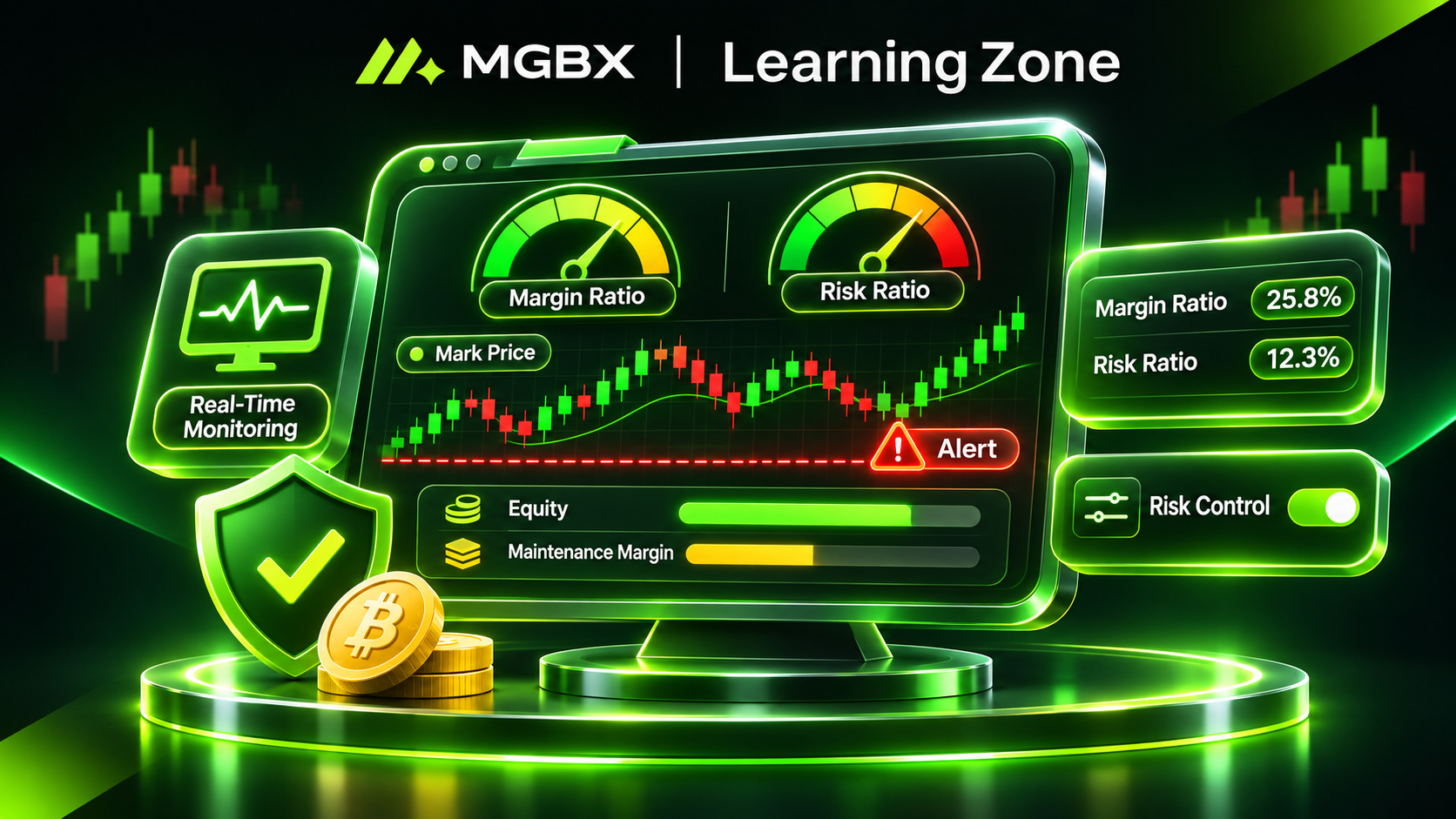
Margin ratios and risk ratios have no universal formula across platforms. A rising value may indicate greater risk or stronger margin coverage. Start by checking each indicator’s definition, calculation scope, and trigger threshold, then monitor equity, maintenance requirements, and mark prices. Estimated liquidation prices and alerts are supporting information, not substitutes for active monitoring. When risk increases, assess position reductions or margin additions against your loss budget rather than automatically adding collateral or opening opposite positions.
How Can Calculations Reveal Changes in Risk?
A margin ratio may express margin as a percentage of position value or equity coverage of maintenance requirements. A risk ratio generally measures how close an account or position is to a risk-control threshold. Similar names do not guarantee identical formulas or directions of change.
Suppose a position has 100 quote-currency units of margin equity and requires 20 units of maintenance margin.
Two platforms using different formulas would display different values:
Calculation | Current Margin Ratio | After Equity Falls to 50 | Risk Change | Typical Meaning |
Maintenance margin ÷ Margin equity | 20 ÷ 100 = 20% | 20 ÷ 50 = 40% | Ratio rises, risk increases | Smaller buffer |
Margin equity ÷ Maintenance margin | 100 ÷ 20 = 500% | 50 ÷ 20 = 250% | Ratio falls, risk increases | Weaker coverage |
This assumes maintenance margin stays at 20, excluding fees and other adjustments. Both formulas describe the same situation: losses reduce margin equity from 100 to 50, shrinking the position’s buffer.
Under the first formula, equity falling to 50 with maintenance requirements unchanged raises the ratio to 40%.
Under the second formula, the same change lowers the ratio from 500% to 250%.
You therefore cannot judge a ratio solely by its name. Check the formula first. The same deterioration can move indicators in opposite directions, so “below 30% is safe” or “above 80% is dangerous” cannot be universal rules. Colors alone cannot establish the remaining buffer either. Follow the platform’s current alert thresholds.
How Do You Build an Effective Position Monitoring Routine?
After opening a position:
Record the margin mode, indicator formula, and trigger conditions.
Recheck equity and maintenance requirements after position changes, asset transfers, or fee deductions.
Monitor other positions in cross margin: overall account risk can worsen even when one position’s price barely changes.
For prices, distinguish the last traded price from the mark price used for risk calculations:
Estimated liquidation prices can change with margin, positions, and risk parameters; they are not permanently fixed.
If stop-loss orders and liquidation use different price references, liquidation conditions may be met before the stop-loss triggers.
When risk increases:
Review your original loss budget.
Reducing a position lowers exposure; adding margin increases supporting collateral. Check that additional commitments remain within your plan.
Be cautious about opening an opposite position. It can increase fees and margin requirements and is not a universal emergency solution.
Monitor markets proactively. Platform notifications may be delayed, so do not wait for an alert before acting.
FAQ
Does a higher margin ratio always mean greater risk?
No. Check the formula. For coverage-based indicators, risk typically increases as the ratio falls.Why is isolated-position risk rising despite an available account balance?
That balance may not support the position. Check whether automatic margin top-ups are enabled and which rules apply.Can the estimated liquidation price change?
Yes. Margin, position size, fees, and risk parameters can affect it.Will I always have time to add margin after an alert?
No. Fast markets can worsen risk rapidly, and alerts do not guarantee time to respond.
Mastering the basics is the first step. Follow MGBX Academy to access more cryptocurrency educational resources and market opportunities.
The process for trading on MGBX:
Register a trading account and complete the necessary identity verification;
Deposit funds and select a trade type;
On the cryptocurrency trading page, enter the amount or quantity of the cryptocurrency you wish to purchase;
Confirm the order to complete the trade, and check that your assets have increased accordingly.
Further Readings:
The Complete Beginner’s Guide to Leverage Trading
What Is Leverage? A Double-Edged Sword for Returns