Complete Guide to Limit Orders: Trading With Precise Price Control
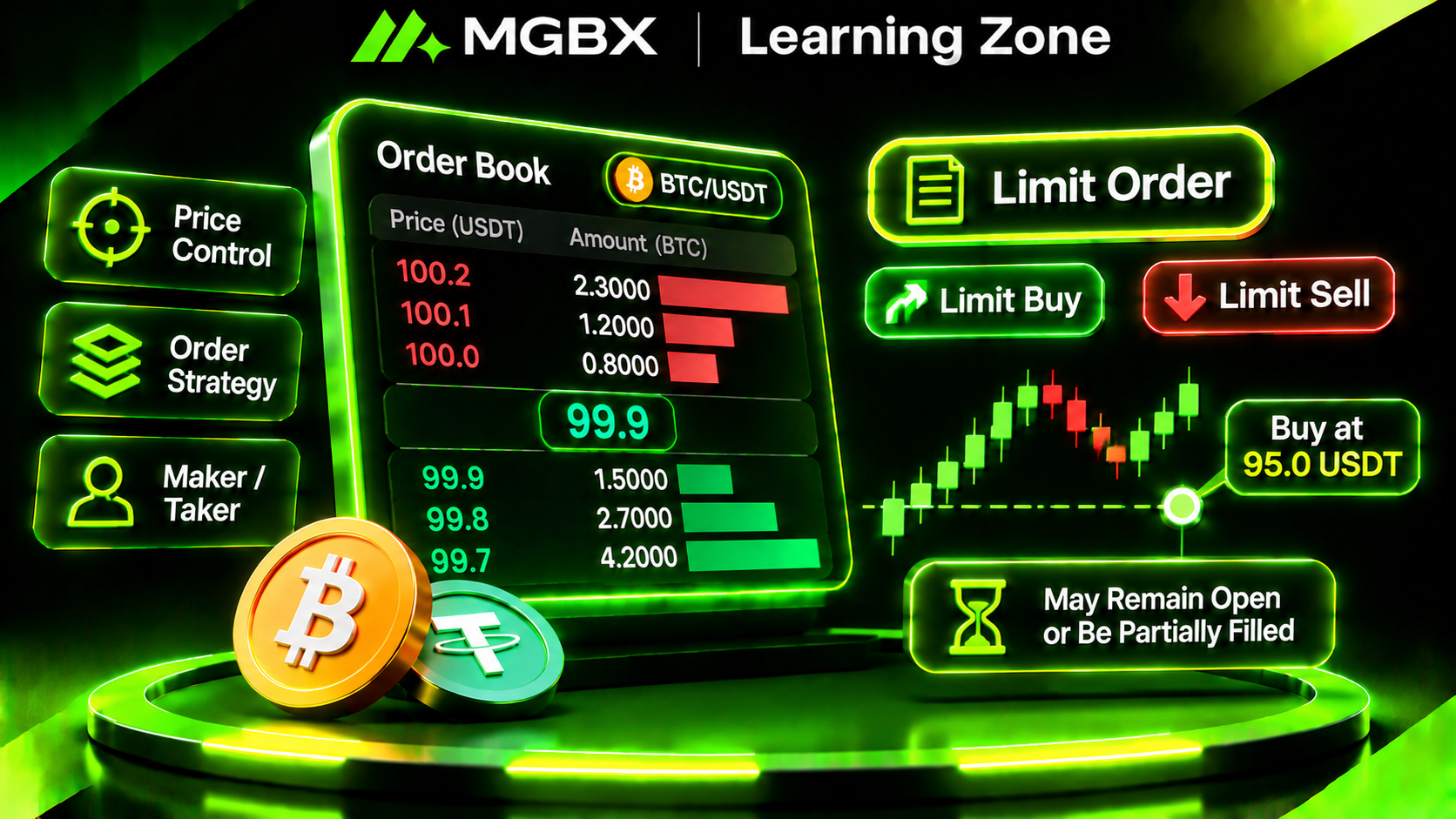
The purpose of a limit order is not to predict the market, but to define the price you are willing to accept before placing a trade. Once a trader sets a maximum buy price or minimum sell price, the order will only execute when matching liquidity becomes available. Compared with market orders, limit orders provide greater price control, but they also come with the possibility of waiting, partial fills, or no execution at all. Understanding order placement, order books, and execution priority is essential to using limit orders effectively.
What Is a Limit Order?
A limit order is an order in which the trader sets an acceptable execution price in advance.
Limit buy order: The trader sets the highest price they are willing to pay.
Limit sell order: The trader sets the lowest price they are willing to accept.
For example, if an asset is trading near 100 USDT but a trader only wants to buy at 95 USDT or below, they can place a limit buy order at 95 USDT. If a matching sell order becomes available, the order may be filled. If the market never reaches that price, the order may remain open.
The main advantage of limit trading is price control, but execution is never guaranteed.
Why Do Some Limit Orders Stay Open While Others Execute Immediately?
Many beginners assume that every limit order simply sits in the order book waiting to be filled, but that is not always the case. Suppose the current best ask is 100 USDT.
Open order: If a trader places a limit buy order at 95 USDT, and there are no sell orders at 95 USDT or below, the order will usually enter the order book and wait.
Immediate execution: If a trader places a limit buy order with a maximum price of 101 USDT, and a sell order is already available at 100 USDT, the order may execute immediately.
Whether a limit order acts as a Maker depends on whether it actually remains in the order book and adds liquidity, not simply on the fact that it is called a limit order.
This is an important concept for understanding both limit trading and order placement strategies.
What Are the Benefits and Risks of Limit Orders?
The clearest advantage of a limit order is that it creates a price boundary for the trade. During periods of high volatility, traders do not have to accept every available market price, which can help reduce unfavorable execution across multiple price levels.
However, greater price control comes with an opportunity cost. If the market never reaches the specified price, the order may remain unfilled. Even if the market briefly touches the limit price, the order is not guaranteed to fill completely because other orders may already be ahead in the queue. For example, if a trader wants to buy 10 units at 95 USDT, but only 3 units are available to match at that price, the order may fill 3 units while the remaining 7 stay open.
How Should You Think About Limit Order Strategies?
The purpose of an order placement strategy is to plan price and quantity in advance, not to guarantee a perfect market bottom or top. For example, instead of buying an entire position at one price, a trader may place several limit orders at different price levels based on their trading plan. This can help structure execution in advance, but it does not guarantee that every order will be filled or that the market will rebound afterward.
The same approach can be used when selling. Traders may place limit sell orders at different prices to exit a position in stages. Ultimately, limit orders provide execution discipline rather than market prediction.
FAQ
Will a limit order always be filled?
No. If no matching order appears at the specified price, the limit order may remain unfilled.Why was my order not filled even though the market touched my limit price?
Other orders may already be ahead at the same price, and the available trading volume may not be enough to fill every order.Is every limit order a Maker order?
No. If a limit order immediately matches with an existing order, it may act as a Taker instead.Can a limit order completely eliminate slippage?
A limit order can prevent execution at a price worse than the specified limit, but it may still be partially filled or not filled at all. Exact execution depends on the platform's order rules.Does an open limit order use available account funds?
In most cases, the required amount of funds or assets is reserved while the order remains open, until it is filled, canceled, or expires. Exact rules may vary by platform.
Mastering the basics is the first step. Follow MGBX Academy to access more cryptocurrency educational resources and market opportunities.
The process for trading on MGBX:
Register a trading account and complete the necessary identity verification;
Deposit funds and select a trade type;
On the cryptocurrency trading page, enter the amount or quantity of the cryptocurrency you wish to purchase;
Confirm the order to complete the trade, and check that your assets have increased accordingly.
Further Readings:
Complete Guide to Spot Trading
What Is Spot Trading? The Simplest Way to Buy Crypto
How Spot Trading Works: A Detailed Guide
Complete Guide to Market Orders: Speed, Benefits, and Risks
Stop-Loss and Take-Profit Orders: Essential Tools for Risk Management