What Is a Spot Trading Pair? How to Choose a Trading Pair
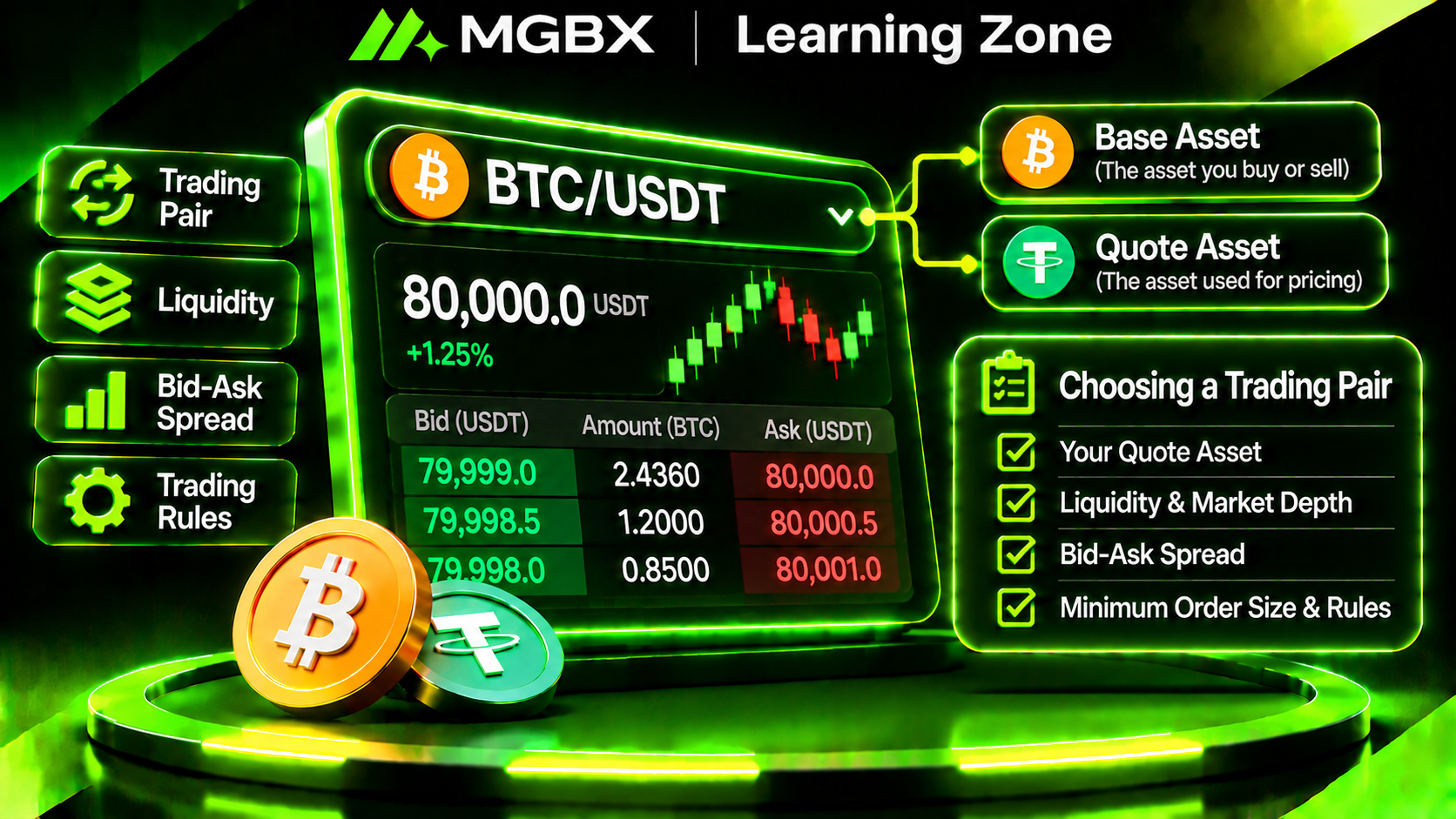
A trading pair is the basic unit used to exchange and price digital assets. In BTC/USDT, for example, BTC is the base asset and USDT is the quote asset, meaning the price shows how much USDT is required for 1 BTC. Different trading pairs have their own order books, trading volumes, and market depth, so even pairs involving the same asset may offer different execution conditions. When choosing a trading pair, consider the quote asset you hold, liquidity, bid-ask spread, order book depth, and trading rules rather than simply comparing the latest displayed price.
What Is a Spot Trading Pair? Using BTC/USDT as an Example
A trading pair consists of two assets that can be exchanged with each other in the same market. It is generally displayed in the form of base asset/quote asset.
Take BTC/USDT as an example. BTC is the base asset, while USDT is the quote asset. If BTC/USDT is quoted at 80,000, it means the market is currently pricing 1 BTC at approximately 80,000 USDT. Buying BTC/USDT means using USDT to purchase BTC, while selling means exchanging BTC for USDT.
The same asset may have multiple trading pairs, such as BTC/USDT and BTC/USDC. Although both involve BTC, each pair has its own order book and supply-demand conditions, so prices, trading volume, and market depth may differ.
Some markets also use assets such as BTC or ETH as the quote asset. For example, an Asset/BTC pair shows the value of that asset relative to BTC. Because the quote asset itself may fluctuate in value, traders should also consider the price risk associated with the asset used for pricing.
Why Can the Same Crypto Have Different Prices Across Trading Pairs?
The price of each trading pair is formed by buying and selling orders in that specific market. An exchange does not simply assign one fixed price to an asset across every pair.
For example, BTC/USDT and BTC/USDC have different buyers, sellers, and order books. If buying demand is stronger in BTC/USDT at a particular moment while supply and demand in BTC/USDC are more balanced, the two markets may temporarily show slightly different prices.
Trading activity often helps narrow these differences over time, but different pairs are not required to display exactly the same quote at every moment.
The latest price also represents only the most recent completed trade. Before placing an order, traders should also look at the best bid, best ask, and the quantity actually available in the order book.
What Should You Consider When Choosing a Spot Trading Pair?
Choosing a trading pair requires considering the quote asset, market depth, bid-ask spread, order size, trading rules, and other factors.
Quote asset: If most of your account balance is held in USDT, a USDT trading pair may allow you to trade directly without making an additional asset conversion.
Liquidity and order book depth: 24-hour trading volume can indicate market activity, but it does not fully represent current liquidity. Even a pair with high reported volume may experience noticeable slippage if only a small amount is available near the best bid or ask.
Bid-ask spread: The wider the gap between the best bid and best ask, the greater the difference between the prices available for an immediate buy and an immediate sell.
Other factors: Minimum order size, price precision, quantity precision, and any platform notices regarding maintenance, suspension, or delisting may also affect whether an order can be executed normally.
Suppose two trading pairs show the latest prices of 99.9 USDT and 100 USDT. The first may appear cheaper, but if only a small quantity is available near 99.9 USDT, a large market buy order may quickly move into higher price levels. By contrast, a pair with a slightly higher displayed price but deeper liquidity may produce an average execution price closer to the original quote.
FAQ
What do BTC and USDT represent in BTC/USDT?
BTC is the base asset and USDT is the quote asset. The price shows how much USDT is required for 1 BTC.Does higher 24-hour trading volume always mean better liquidity?
Not necessarily. Trading volume is one reference point, but bid-ask spreads, order book depth, and available quantity near the best prices should also be considered.Are stablecoin trading pairs completely free from quote-asset risk?
No. Stablecoins are generally designed to maintain a relatively stable value, but they may still experience deviations from their intended peg or other market-related risks.What should I check first when choosing a trading pair?
Start by identifying the base and quote assets, then review liquidity, spreads, order book depth, and the relevant trading rules.
Mastering the basics is the first step. Follow MGBX Academy to access more cryptocurrency educational resources and market opportunities.
The process for trading on MGBX:
Register a trading account and complete the necessary identity verification;
Deposit funds and select a trade type;
On the cryptocurrency trading page, enter the amount or quantity of the cryptocurrency you wish to purchase;
Confirm the order to complete the trade, and check that your assets have increased accordingly.
Further Readings:
Complete Guide to Spot Trading
What Is Spot Trading? The Simplest Way to Buy Crypto