Applying Elliott Wave Theory to Cryptocurrency Markets

Elliott Wave Theory analyzes market trends through recurring price structures, dividing market movements into impulse waves and corrective waves. A classic cycle consists of five impulse waves followed by three corrective waves, with smaller wave structures nested within larger ones. In cryptocurrency markets, this theory can help traders identify trend phases and potential correction areas. However, wave counting involves subjective interpretation and should not be treated as a reliable price prediction method. Combining Fibonacci ratios, moving averages, trading volume, and price structure can help reduce the limitations of relying on wave counts alone.
What Is Elliott Wave Theory?
Elliott Wave Theory was developed by Ralph Nelson Elliott. Its central principle is that market prices form recurring wave patterns influenced by shifts in collective market sentiment. Classic Elliott Wave Theory divides market movements into impulse waves and corrective waves. An impulse wave typically consists of five subwaves, while a corrective wave generally consists of three. Larger wave structures can also be subdivided into smaller waves.
In cryptocurrency markets, this fractal structure can help traders examine broader trends and identify potential pullbacks and rebounds across different timeframes. However, Elliott Wave Theory is not exclusive to digital assets, and there is no single wave-counting method that always produces a definitive interpretation. Multiple valid wave counts may exist in practical analysis. Therefore, it is better used as a probabilistic analytical framework rather than a standalone basis for trading decisions.
To build a more comprehensive technical analysis framework, explore A Beginner's Guide to Crypto Technical Analysis: From Candlesticks to a Trading System.
How to Identify the Five-Wave Structure: Key Wave-Counting Rules
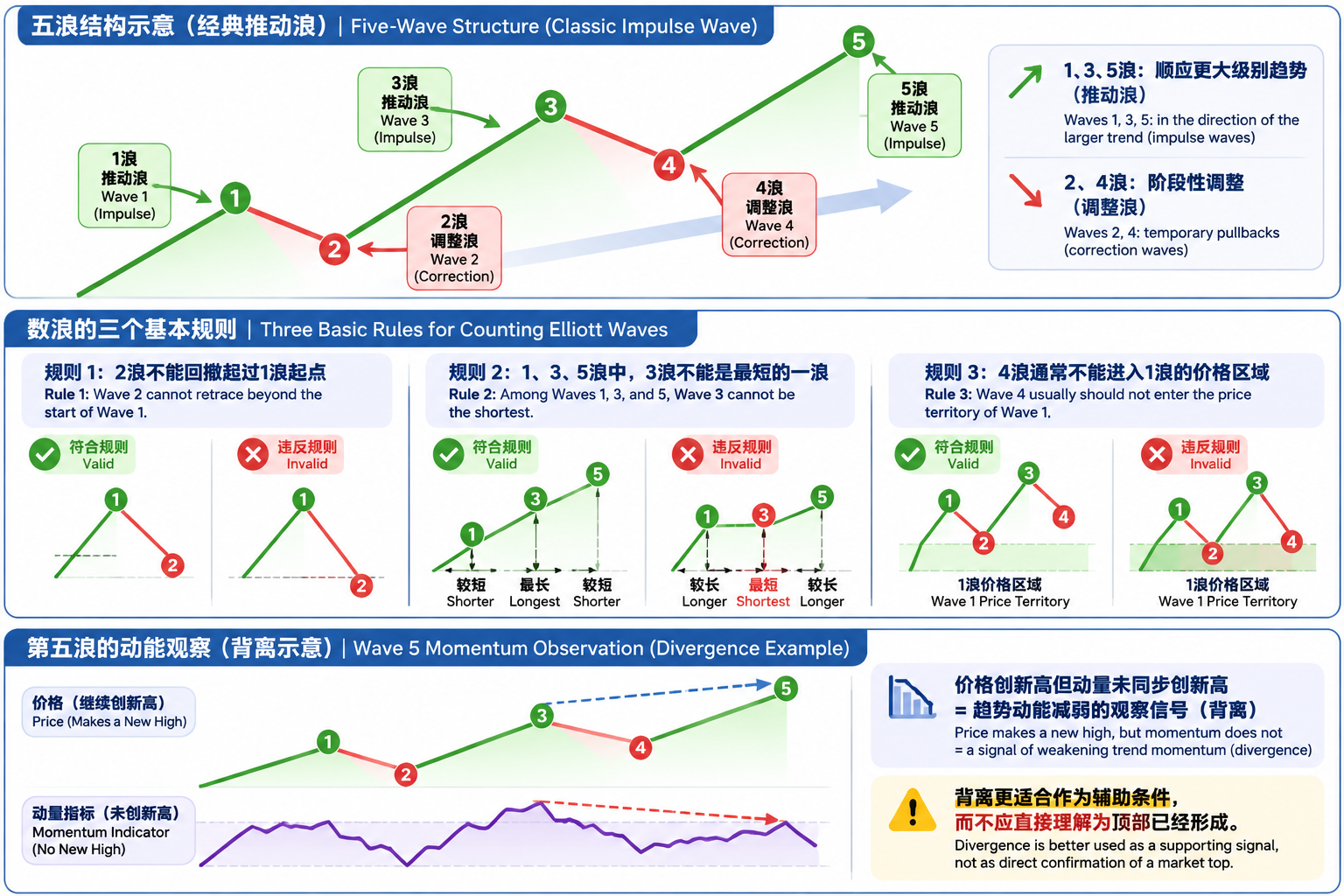
A classic impulse wave typically consists of Waves 1, 2, 3, 4, and 5. Waves 1, 3, and 5 move in the direction of the larger trend, while Waves 2 and 4 are temporary corrective movements.
When counting waves, traders should check three fundamental rules. Wave 2 cannot retrace beyond the starting point of Wave 1. Among Waves 1, 3, and 5, Wave 3 cannot be the shortest. Wave 4 typically should not enter the price territory of Wave 1. If these conditions are clearly violated, the current wave count should be reassessed.
Momentum during Wave 5 can also be monitored using trading volume and other momentum indicators. For example, if the price continues making new highs but the momentum indicator fails to reach corresponding new highs, this may signal weakening trend momentum. However, such divergence is better treated as a supporting signal rather than direct confirmation that a market top has formed.
How to Combine Fibonacci Ratios with Other Indicators
Elliott Wave Theory is frequently used alongside Fibonacci ratios. Common reference levels include 38%, 50%, and 62% retracements, which can help traders identify potential support areas during corrective waves. Actual retracement depths may vary significantly across assets and market conditions, so these ratios should be treated as reference zones rather than fixed targets.
In cryptocurrency markets, traders can first use moving averages to identify the broader trend, then use wave structures to examine potential pullback phases and trading volume to assess whether price movements are supported by trading activity.
MACD can also help monitor changes in market momentum. When multiple analytical tools provide consistent signals, the overall assessment is generally more comprehensive than relying on wave counts alone.
Frequently Asked Questions
Can Elliott Wave Theory accurately predict Bitcoin prices?
No. It helps analyze potential market structures and probabilities but cannot guarantee that future prices will follow a particular wave pattern.Is Wave 3 always the longest wave?
No. The classic rule states that Wave 3 cannot be the shortest among Waves 1, 3, and 5. This does not necessarily mean it must always be the longest.Is Elliott Wave Theory suitable for cryptocurrency markets?
Yes, it can be used as a supplementary analytical tool, but traders should combine it with price structure, trading volume, trend indicators, and risk management rather than relying on wave counts alone.
Mastering the basics is the first step. Follow MGBX Academy to access more cryptocurrency educational resources and market opportunities.
The process for trading on MGBX:
Register a trading account and complete the necessary identity verification;
Deposit funds and select a trade type;
On the cryptocurrency trading page, enter the amount or quantity of the cryptocurrency you wish to purchase;
Confirm the order to complete the trade, and check that your assets have increased accordingly.